
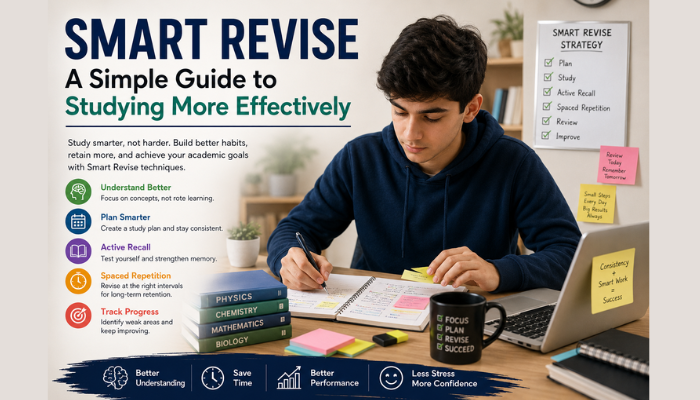

Smart Revise is more than just a study method—it is a structured way of learning that helps students absorb, retain, and recall information more effectively. In a world where distractions are everywhere and academic pressure keeps increasing, smart revision techniques are becoming essential for success. Whether you are preparing for school exams, university assessments, or professional certifications, using smart revise strategies can completely change the way you approach studying.
Instead of relying on long hours of repetitive reading, Smart Revise focuses on active learning techniques that strengthen memory and understanding. This approach helps learners study with purpose, reduce stress, and improve long-term retention. In this article, we will explore how Smart Revise works, why it is effective, and how you can apply it in your daily study routine.
What is Smart Revise and Why It Matters
Smart Revise is a modern learning approach that focuses on efficient revision techniques rather than traditional memorization. It encourages students to actively engage with study material through methods like summarization, self-testing, spaced repetition, and concept mapping. The goal is not just to read information but to understand and retain it for longer periods.
What makes Smart Revise important is its focus on productivity and effectiveness. Many students spend hours revising without seeing real improvement in their performance. Smart Revise changes this by ensuring that every minute of study time is meaningful. It helps learners identify weak areas, strengthen understanding, and build confidence before exams.
Another key advantage of Smart Revise is that it reduces cognitive overload. Instead of cramming large amounts of information at once, students break their learning into manageable parts. This structured approach makes studying less overwhelming and more organized, leading to better academic results.
Core Principles Behind Smart Revise Techniques
At the heart of Smart Revise are several proven learning principles that improve memory retention. One of the most important is active recall, which involves testing yourself instead of passively reading notes. This technique forces the brain to retrieve information, strengthening neural connections and improving recall during exams.
Another core principle is spaced repetition. This method involves reviewing material at increasing intervals over time. Instead of revising everything in one sitting, students revisit topics multiple times, which helps move information from short-term to long-term memory. This makes studying more efficient and reduces last-minute exam stress.
Smart Revise also emphasizes understanding over memorization. When students understand concepts deeply, they can apply knowledge in different contexts rather than simply repeating facts. This improves problem-solving skills and makes learning more meaningful across all subjects.
Benefits of Using Smart Revise in Daily Study Routine
One of the biggest benefits of Smart Revise is improved memory retention. By using structured techniques like repetition and active recall, students are able to remember information for longer periods without constant re-reading. This leads to more confidence during exams and assessments.
Another major benefit is better time management. Smart Revise helps students prioritize important topics and avoid wasting time on ineffective study methods. Instead of spending hours rereading textbooks, learners focus on high-impact revision strategies that produce better results in less time.
Smart Revise also reduces stress and anxiety. When students have a clear revision plan and understand their progress, they feel more in control of their studies. This structured approach eliminates last-minute panic and helps create a calm, focused learning environment.
How to Apply Smart Revise for Maximum Results
To effectively apply Smart Revise, students should start by creating a structured study plan. This includes breaking subjects into smaller topics and scheduling regular revision sessions. Consistency is key, as frequent short sessions are more effective than long, irregular study hours.
Another important step is using active learning tools such as flashcards, quizzes, and practice tests. These tools encourage recall and help identify areas that need improvement. Digital apps and study planners can also enhance the Smart Revise experience by organizing content and tracking progress.
Finally, students should regularly review and adjust their study methods. Not every technique works equally for everyone, so it is important to experiment and find what works best. Combining different Smart Revise strategies can significantly improve learning efficiency and academic performance.
Common Mistakes Students Make While Revising
One common mistake is passive reading. Many students believe that simply reading notes repeatedly is enough, but this method is not very effective. Without active engagement, the brain does not retain information efficiently, leading to poor recall during exams.
Another mistake is last-minute cramming. Trying to learn everything in a short period creates stress and reduces comprehension. Smart Revise encourages consistent revision over time, which leads to better understanding and long-term retention.
Students also often ignore weak areas and focus only on topics they already understand. This creates an imbalance in preparation. Smart Revise promotes balanced learning by identifying weak points and giving them extra attention, ensuring complete subject coverage.
Build a Smart Revise System: Plan, Schedule, and Prioritize
A common revision mistake is treating all studying time as equal. Smart revise replaces that assumption with a flexible system: a schedule that responds to your progress. Begin by reviewing your syllabus or learning goals and break them into smaller topics. Then, create a priority ranking based on difficulty and importance. For example, a core concept that appears in multiple units should be high priority—even if it feels slightly challenging.
Once you have topic lists, schedule your revision using a practical rhythm. Rather than attempting a massive one-week cram cycle, smart revise works best when you distribute review sessions. Even a simple cadence—like reviewing key topics 1 day later, then 3 days later, then 1 week later—can significantly improve retention. The goal is to catch forgetting early and reinforce memory right before it fades.
Another essential element of a smart revise system is planning for feedback. If you only study and never check understanding, you may “feel productive” while learning stays shallow. Add checkpoints: quizzes, short recall sessions, or “teach-back” mini lessons. These moments reveal what’s working and what’s not, allowing you to adjust the next revision session with confidence.
When prioritizing, use a method that keeps decisions simple. One effective approach is the “2-pass rule.” First pass: quickly scan topics and identify what you can recall easily. Second pass: focus deeply on what you struggle with. That second pass is where smart revise shines, because it targets the highest-return content.
A creative twist for smart revise planning is to match revision tasks to energy levels. For example:
- Use high-energy time for practice questions or complex problem-solving.
- Use lower-energy time for flashcards, summarizing, or reviewing diagrams.
This way, your revision system works with your natural focus patterns, not against them.
Use Smart Revise Techniques That Boost Memory Fast
The best smart revise strategies share a single trait: they make you actively engage with the material. Passive rereading might feel helpful, but retrieval practice is what turns information into something you can recall under pressure. Start using techniques that force your brain to work.
Retrieval Practice (Instead of Rereading)
Retrieval practice means you try to bring information to mind without looking. This can be done with:
- “Blank page” summaries
- Practice questions
- Explaining a concept out loud
- Making self-made quizzes
If you consistently test yourself, your brain treats the information as meaningful and searchable. Over time, what used to feel difficult becomes familiar—exactly the type of transformation smart revise is designed to create.
Spaced Repetition (Review at the Right Time)
Spaced repetition is the idea that you review information just as you start to forget it. That timing is what strengthens long-term memory. Smart revise benefits greatly from spaced review cycles because it prevents the “I remember it yesterday” trap.
Even if you don’t use fancy apps, you can still apply spaced repetition manually:
- Review topic A after 1 day
- Review again after 3 days
- Review again after 7 days
- Then continue based on performance
Interleaving (Mix Topics for Stronger Transfer)
Interleaving means mixing similar topics rather than studying one topic for hours. It feels harder at first, but that difficulty builds discrimination—your brain learns to tell the difference between concepts. For example, instead of practicing only one math procedure, alternate between related types of problems. Smart revise uses interleaving to improve your ability to select the correct method during an exam.
Elaboration (Connect Ideas)
Elaboration is where you add meaning. Ask “why” and “how” questions:
- Why does this rule work?
- How does this concept connect to earlier ideas?
- What real-world example illustrates it?
Smart revise encourages elaboration because explanation deepens understanding. When you can describe the “reason behind” a topic, you’re less likely to forget and more likely to solve unfamiliar questions.
Feedback Loops (Fix Weak Spots Immediately)
After each practice session, review mistakes quickly. Then rewrite or reframe the concept. A mistake is not just an error—it’s data. Smart revise treats feedback as fuel.
A powerful creative approach is to maintain a “revision error journal.” Each time you miss something, record:
- What you thought would happen
- What actually happened
- The correct rule/concept
- A short strategy to avoid repeating it
This makes your next revision session sharper, faster, and more targeted.
Smart Revise for Different Subjects: What to Use Where

Smart revise isn’t one-size-fits-all. Different subjects require different revision formats because they test different skills—memorization, reasoning, writing, problem-solving, or applied understanding. The key is to match your revision tools to the subject’s demands.
For Science and Technical Subjects
Technical subjects often require both concept understanding and procedural skill. Smart revise works best here when you combine:
- Retrieval practice for definitions and theories
- Step-by-step practice for calculations or problem-solving
- Diagram review (and redrawing diagrams from memory)
A great strategy is to alternate between “concept recall” and “problem execution.” For example, revise the theory first, then immediately apply it to a related problem. This builds a bridge between understanding and performance.
For History and Humanities
Humanities rely heavily on recall, structure, and narrative. Smart revise can help by using:
- Timeline recall drills
- Flashcards for key dates and terms
- Practice essays with outlines (not just final drafts)
- Teach-back summaries in your own words
Instead of memorizing paragraphs, focus on frameworks: causes, effects, key players, and turning points. When you structure your recall, writing becomes easier because you’re pulling from an organized mental map.
For Languages
Language learning is ideal for smart revise because revision can be interactive. Use:
- Active recall for vocabulary (flashcards or word prompts)
- Speaking or recording yourself
- Grammar drills where you convert sentences
- Reading short texts and summarizing
Smart revise for languages should include daily micro-practice because consistency builds automaticity. Even 10–15 minutes a day can outperform occasional long sessions.
For Math and Coding
Math and coding require practice, not just study. Smart revise techniques here include:
- Mixed problem sets (interleaving)
- Timed practice
- Debugging mistakes immediately
- Rewriting solutions and explaining steps
For coding, use short “build-and-test” cycles. Write a small program, test it, identify errors, then refine. That loop is essentially smart revise in action: diagnose, adjust, and improve.
Make Smart Revise Sustainable: Beat Procrastination, Burnout, and Confusion
The hardest part of revision isn’t knowing what to do—it’s doing it consistently. Smart revise is designed to be sustainable, because you’ll only improve if your revision routine can survive real life: stress, distractions, and fatigue.
Start Smaller Than You Think
If your revision plan feels intimidating, break it down into a “starter size.” For example:
- 10 minutes of retrieval practice
- 15 flashcards
- 1 practice question
- 1 teach-back explanation
Smart revise wins by removing friction. Once you start, momentum often follows.
Use “If-Then” Rules for Self-Control
Procrastination often thrives on unclear next steps. Instead, define rules:
- If it’s 7:00 PM, then I do 20 minutes of practice questions.
- If I feel stuck, then I review one example and try again.
- If I miss a session, then I do a shorter one the next day.
These simple statements make smart revise automatic and reduce decision fatigue.
Avoid Passive Traps
Many people confuse revision with re-exposure. If you’re rereading for an hour and you can’t explain anything afterward, you need more retrieval. A smart revise rule: if your revision session doesn’t produce evidence (answers, explanations, recall), it’s probably not working.
Manage Energy and Time
Burnout happens when revision becomes all-or-nothing. Smart revise encourages planned recovery:
- short breaks between tasks
- longer breaks after challenging sessions
- sleep and hydration as part of the plan (yes, these matter)
Memory consolidates during rest. If you cut sleep, you often cut learning effectiveness.
Track Progress in a Simple Way
Progress tracking makes revision feel rewarding. Don’t track everything—track what matters:
- quiz scores
- number of topics “mastered”
- reduction in repeated mistakes
Smart revise turns revision into a measurable improvement journey, which makes it easier to stay motivated.
Conclusion
Smart Revise is a powerful and practical approach to studying that helps students learn more efficiently and retain information longer. By focusing on active learning, structured revision, and consistent practice, it transforms the way students prepare for exams. Instead of relying on traditional memorization, Smart Revise encourages smarter, more effective study habits that lead to real academic improvement.
Whether you are a beginner or an advanced learner, adopting Smart Revise techniques can make your study sessions more productive, less stressful, and far more rewarding.
FAQs
1. What is Smart Revise?
Smart Revise is a study method that focuses on active learning techniques to improve memory and understanding.
2. Is Smart Revise suitable for all students?
Yes, it can be used by school students, university learners, and professionals.
3. How does Smart Revise improve memory?
It uses techniques like active recall and spaced repetition to strengthen long-term memory.
4. Can Smart Revise reduce exam stress?
Yes, because it promotes structured and consistent revision.
5. What is the best way to start Smart Revise?
Start by creating a study plan and using active learning tools like flashcards.
6. Is Smart Revise better than traditional studying?
It is generally more effective because it focuses on understanding rather than memorization.
7. How often should I revise using Smart Revise?
Short, frequent study sessions are recommended for best results.
8. Does Smart Revise work for difficult subjects?
Yes, especially when combined with practice and concept-based learning.
9. Can digital tools help with Smart Revise?
Yes, apps and planners can make revision more organized and efficient.
10. What is the biggest mistake to avoid?
Avoid passive reading and last-minute cramming, as they reduce retention.