
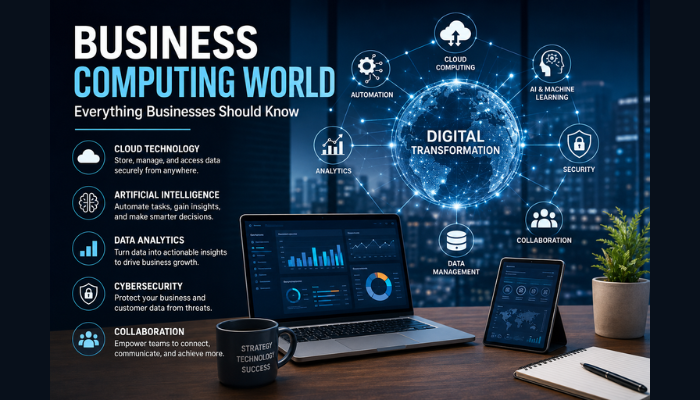

Business computing world is no longer just about using computers in the workplace. It has evolved into a complete digital ecosystem where businesses leverage technology to improve productivity, automate repetitive tasks, strengthen cybersecurity, analyze data, and deliver exceptional customer experiences. Whether you’re running a startup, managing a growing enterprise, or simply interested in modern business technology, understanding the business computing world has become essential.
From cloud computing and artificial intelligence to business analytics and cybersecurity, technology continues to reshape how organizations operate. Companies that embrace digital transformation often gain a competitive advantage by improving efficiency, reducing operational costs, and making faster, data-driven decisions.
In this comprehensive guide, we’ll explore the business computing world, the technologies driving innovation, the benefits and challenges organizations face, and what the future holds for businesses operating in an increasingly digital environment.
What Is the Business Computing World?
The business computing world refers to the integration of computer technologies, software applications, digital infrastructure, and information systems into everyday business operations. It encompasses everything from office productivity software and enterprise resource planning (ERP) systems to cloud services, cybersecurity platforms, and advanced analytics tools.
Businesses rely on computing technologies to manage finance, inventory, customer relationships, communication, human resources, marketing, and operations. Instead of depending on manual processes, organizations automate workflows that save time while improving accuracy and consistency.
Today’s business computing environment is highly connected. Employees collaborate remotely through cloud-based platforms, executives analyze real-time dashboards, and customers interact with companies through digital channels. As technology continues to evolve, computing has become the foundation that supports nearly every aspect of modern business strategy.
Furthermore, organizations are increasingly investing in digital infrastructure to remain competitive. Reliable networks, secure databases, and intelligent software solutions allow businesses to respond quickly to changing market demands while maintaining operational efficiency.
Core Technologies Powering the Business Computing World
Several technologies define today’s business computing world, each playing a critical role in digital transformation.
Cloud computing has revolutionized how businesses access software and store information. Instead of maintaining expensive on-site servers, organizations now use cloud platforms that offer flexibility, scalability, and reduced infrastructure costs. Employees can securely access business systems from virtually anywhere, making hybrid and remote work more practical than ever.
Artificial intelligence (AI) and machine learning are transforming business decision-making. AI-powered tools automate customer support, analyze large datasets, detect fraud, forecast demand, and personalize marketing campaigns. These intelligent systems help organizations improve productivity while reducing repetitive manual work.
Business intelligence and data analytics enable companies to convert raw information into actionable insights. Interactive dashboards and reporting tools help leaders identify trends, monitor performance, and make informed strategic decisions.
Cybersecurity has become equally important. As businesses collect more digital information, protecting sensitive customer data and business assets is essential. Firewalls, endpoint protection, multi-factor authentication, encryption, and continuous monitoring help reduce security risks and ensure compliance with industry regulations.
Benefits of Business Computing for Modern Organizations
One of the biggest advantages of the business computing world is improved operational efficiency. Automation eliminates repetitive administrative tasks, allowing employees to focus on strategic work that creates greater value. Faster workflows improve productivity while reducing the likelihood of human error.
Technology also enhances collaboration. Cloud-based communication platforms, project management software, and shared workspaces enable teams to collaborate regardless of location. This flexibility supports hybrid work environments while improving communication across departments.
Another significant benefit is better decision-making. Organizations generate enormous amounts of data every day. Business computing solutions organize, analyze, and visualize this information, enabling managers to identify opportunities, reduce risks, and allocate resources more effectively.
Customer satisfaction also improves through digital technologies. CRM systems help businesses understand customer preferences, provide personalized experiences, respond faster to inquiries, and strengthen long-term relationships. These improvements often lead to higher customer retention and increased revenue.
Cost optimization is another key advantage. Cloud services reduce hardware investments, automation lowers labor costs, predictive maintenance minimizes downtime, and digital workflows reduce paper-based processes. Together, these improvements contribute to long-term business sustainability.
Challenges in the Business Computing World
Despite its advantages, the business computing world presents several challenges that organizations must carefully manage.
Cybersecurity remains one of the biggest concerns. Data breaches, ransomware attacks, phishing campaigns, and insider threats continue to evolve in sophistication. Businesses must regularly update security policies, educate employees, and invest in modern cybersecurity technologies to protect sensitive information.
Technology adoption can also be difficult. Employees may resist change, especially when organizations introduce unfamiliar software or automated systems. Effective training programs and clear communication help employees adapt while maximizing the value of new technologies.
Integration is another common challenge. Many organizations use multiple software platforms that must work together seamlessly. Poor integration can create data silos, duplicate work, and reduce productivity. Choosing compatible systems and experienced implementation partners can minimize these issues.
Budget constraints may also limit digital transformation initiatives. Although technology often produces long-term savings, initial investments in software, infrastructure, consulting, and employee training require careful financial planning. Businesses should prioritize solutions that align with their strategic objectives and expected return on investment.
The Modern Business Computing World: From Infrastructure to Strategy
A common misconception is that the business computing world is purely technical. In reality, the most successful computing strategies blend technology with business outcomes. Infrastructure decisions—like whether workloads run on-premises, in the cloud, or in a hybrid model—determine how quickly you can launch new services, how reliably systems perform, and how efficiently you can respond to changing market conditions.
To understand the business computing world, think in layers: compute, storage, networking, databases, applications, data pipelines, security, identity, and governance. Each layer affects the others. For example, choosing cloud services influences how you secure access, how you manage data residency, and how you implement disaster recovery. Even at the “infrastructure” level, strategy is built into the design.
Beyond layers, the best approach is to align computing architecture with business priorities. If your top priority is customer responsiveness, you’ll focus on latency, scalable services, and application performance. If your priority is compliance, you’ll emphasize auditability, encryption, access controls, and policy-based governance. If your priority is cost control, you’ll implement workload sizing, automation, and monitoring that prevents resource waste.
As you evaluate your computing direction, ask these strategic questions:
- What business capabilities must we deliver faster?
- Where are we experiencing bottlenecks—people, processes, or technology?
- Which systems are mission-critical, and which can tolerate downtime?
- How can we reduce operational overhead without sacrificing control?
When you connect technology choices to business outcomes, the business computing world becomes a competitive advantage—not a cost center.
Just as important is the shift from “big redesigns” to continuous improvement. Modern computing is iterative: you can start with a few high-impact workloads, validate results, then expand. This approach reduces risk and helps your team build expertise over time. It also ensures your computing strategy remains adaptable as tools, regulations, and customer expectations evolve.
Cloud, Hybrid, and Edge: Choosing the Right Computing Model
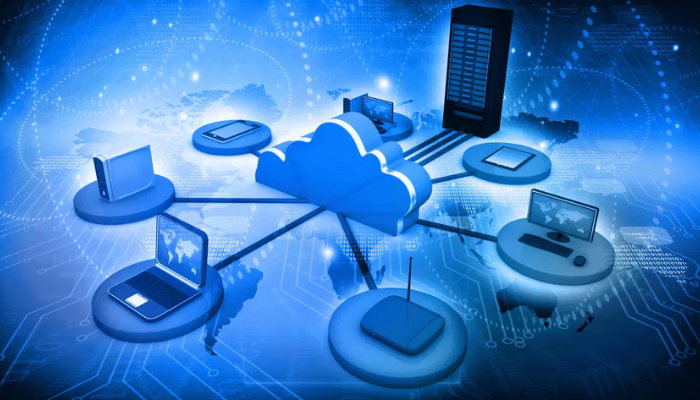
Cloud computing is one of the most transformative trends in the business computing world, largely because it turns infrastructure into a service. Instead of investing heavily in hardware upfront, businesses can use managed platforms that scale with demand. That scalability is crucial during seasonal spikes, product launches, and unpredictable usage changes.
However, “cloud-first” doesn’t mean “cloud-only.” Many organizations operate in a hybrid model, combining on-prem systems with cloud services. Hybrid strategies help businesses keep certain workloads close to data centers—such as legacy applications, tightly regulated data, or specialized equipment—while still benefiting from cloud agility for newer workloads.
The business computing world also includes edge computing, which pushes computation closer to where data is generated. This is especially valuable in scenarios requiring low latency—like manufacturing systems, retail analytics, logistics tracking, or real-time customer experiences. Edge doesn’t replace cloud; it complements cloud by handling immediate processing while sending aggregated insights upstream.
So how do you choose the right computing model?
- Cloud is ideal for elastic workloads, rapid deployment, managed databases, and services that benefit from global availability.
- On-premises can be useful for highly customized environments, strict local control requirements, or systems deeply integrated with existing infrastructure.
- Hybrid works well when modernization is gradual, compliance constraints exist, or you need to reduce migration risk.
- Edge is best when real-time processing matters more than centralized control.
A practical path for many businesses is to begin with “low-to-medium risk” workloads, such as internal collaboration tools, analytics dashboards, or non-critical web services. Then, build capability around security and monitoring before migrating more complex systems.
Cloud adoption also changes how you think about reliability. You move from hardware-centric maintenance to service-centric reliability. That means you must understand shared responsibility models, implement multi-region resilience where needed, and define clear recovery objectives. Reliability planning becomes a business process, not just an IT task.
Finally, cloud and edge strategies should be guided by governance. The business computing world rewards teams that standardize patterns: identity management, encryption defaults, logging practices, tagging conventions for cost control, and consistent deployment workflows. Standardization doesn’t limit creativity—it improves speed and safety across the organization.
Data and AI in the Business Computing World: Turning Information into Advantage
Data is the fuel of modern computing. In the business computing world, the question isn’t whether you have data—it’s whether you can transform raw information into decisions, automation, and improved experiences. This is where analytics and AI become powerful.
Start with data foundations. Businesses often struggle because data exists in silos: different departments use different tools, records are stored in incompatible formats, and reporting takes too long. A strong computing strategy includes data modeling, data governance, and integration planning. When data is consistent and accessible, teams can build faster and trust their insights more.
Once the foundation is ready, analytics helps you answer operational questions: What products sell best in which regions? Where do customers drop off in onboarding? Which processes cause delays? With modern data platforms, you can create dashboards, predictive models, and automated reporting that keeps stakeholders aligned.
AI brings a new layer. In the business computing world, AI can assist with:
- customer support via intelligent chat and knowledge search,
- sales forecasting and demand planning,
- anomaly detection for operational monitoring,
- document processing and automated classification,
- personalization in marketing experiences,
- intelligent automation for repetitive tasks.
Yet AI success depends on more than deploying a model. You need quality data, well-defined objectives, and monitoring for drift and bias. You also need human-in-the-loop processes for high-stakes outcomes. Creative innovation should be paired with responsible governance so you can scale AI safely.
Another key concept is “operational analytics,” which means using insights where decisions happen—within business workflows. Instead of sending reports only at the end of the week, you can implement real-time signals that alert teams instantly. In other words, the business computing world becomes proactive, not reactive.
To get value from AI and data, consider these implementation principles:
- Define measurable business outcomes (e.g., reduced churn, faster response time).
- Begin with use cases that have accessible data and clear feedback loops.
- Build repeatable pipelines for ingestion, transformation, and monitoring.
- Establish model governance, including evaluation and safety checks.
- Train teams on how to interpret results and act on them.
When data and AI are treated as a business capability—supported by scalable computing—they become an engine for competitive advantage.
Cybersecurity and Identity: Protecting the Core of Business Computing
If there’s one area where the business computing world demands seriousness, it’s security. As businesses adopt cloud services, integrate apps through APIs, and rely on remote work tools, the attack surface expands. Threats evolve too—ransomware, phishing campaigns, credential stuffing, misconfigurations, and supply-chain risks can all disrupt operations.
Modern security starts with identity. In practice, identity is the gatekeeper to systems, data, and applications. Strong identity management includes:
- multi-factor authentication (MFA),
- least privilege access,
- role-based access control (RBAC),
- secure onboarding and offboarding processes,
- continuous access review.
Next is encryption and secure data handling. Encryption should protect data in transit and at rest. But encryption alone isn’t enough—businesses also need policies for key management, secure backups, and controlled access.
Another essential pillar is secure configuration. In the business computing world, misconfigurations are a major cause of breaches, especially in cloud environments. Organizations should enforce secure baselines, use infrastructure-as-code with review workflows, and implement automated checks that detect risky settings early.
Logging and monitoring are also vital. You need visibility to detect unusual behavior and respond quickly. That means centralized logging, alerting rules, and incident response playbooks. When an incident happens, speed matters: the faster you contain and remediate, the less damage you experience.
It’s also important to train people. Many security incidents begin with human factors like phishing. Security awareness programs, simulated phishing exercises, and clear reporting channels help reduce risk without making employees feel overwhelmed or unsafe.
Finally, security must support business continuity. That includes disaster recovery planning, regular backups, and testing restore procedures. Many organizations discover—too late—that backups weren’t functioning properly or that recovery processes weren’t practiced.
In today’s business computing world, security isn’t a one-time project. It’s an ongoing operating model that combines technology, process, and people.
Cost, Performance, and Governance: Making Computing Sustainable at Scale
As businesses grow, computing can become expensive and complex. In the business computing world, cost overruns often happen silently: unused resources, poorly sized instances, inefficient data transfers, and duplicate tools can accumulate into significant waste. The goal isn’t just cutting costs—it’s improving the value delivered per computing resource.
Cost management starts with visibility. Teams need dashboards and reporting that connect expenses to workloads, owners, environments, and usage patterns. Without this, optimization becomes guesswork. A strong tagging strategy, consistent naming conventions, and automated cost allocation can turn cloud spend into actionable insight.
Performance management matters just as much. If systems are slow, customers will notice—even if your security is strong and your data is clean. Performance optimization can include:
- caching strategies,
- database tuning and indexing,
- asynchronous processing for long-running tasks,
- workload separation,
- content delivery improvements,
- monitoring that identifies bottlenecks before they become incidents.
Governance ties everything together. Governance includes policies and guardrails that keep the organization aligned. That might involve:
- standardized deployment pipelines (e.g., CI/CD),
- approved tool catalogs and security baselines,
- compliance controls and audit logging,
- data retention policies,
- change management workflows.
In creative terms, governance is like the rails on a roller coaster: it enables speed and excitement without derailing. Without governance, teams may move faster initially, but the long-term result is instability, technical debt, and security risk.
Sustainable computing also depends on talent and process. You may need new roles or training: cloud architects, security engineers, platform engineers, data engineers, and product-minded engineers. When teams understand the “why” behind computing standards, adoption improves.
The most successful business computing world strategies treat technology like a living system. You continuously refine architectures, automate routine tasks, update security practices, and improve observability. Over time, that creates resilience: your business becomes better at launching new capabilities while staying secure and cost-effective.
Future Trends Shaping the Business Computing World
The future of the business computing world will be driven by continuous innovation. Artificial intelligence will become increasingly integrated into everyday business operations, supporting decision-making, predictive analytics, customer service, and workflow automation.
Edge computing will complement cloud computing by processing data closer to where it is generated. This reduces latency, improves performance, and supports applications requiring real-time processing, such as smart manufacturing and Internet of Things (IoT) devices.
Automation will continue expanding beyond repetitive tasks. Intelligent process automation will combine AI, robotics, and advanced analytics to streamline complex business operations with minimal human intervention.
Cybersecurity will remain a top priority as organizations adopt more connected technologies. Zero-trust security models, behavioral analytics, and AI-driven threat detection will become standard practices for protecting digital assets.
Businesses will also place greater emphasis on sustainability. Energy-efficient data centers, environmentally responsible IT practices, and digital solutions that reduce waste will contribute to corporate sustainability goals while supporting long-term business growth.
Organizations that embrace innovation while maintaining strong governance and security practices will be better positioned to succeed in an increasingly competitive digital economy.
Conclusion
The business computing world has become the backbone of modern organizations. From cloud computing and artificial intelligence to cybersecurity and business analytics, technology enables businesses to operate more efficiently, make informed decisions, and deliver outstanding customer experiences.
Although challenges such as cybersecurity risks, technology integration, and employee adoption remain important considerations, the long-term benefits significantly outweigh the obstacles. Businesses that invest strategically in digital transformation can improve productivity, strengthen competitiveness, and prepare for future technological advancements.
As innovation continues to reshape industries, understanding the business computing world is no longer optional—it’s an essential part of building resilient, efficient, and future-ready organizations.
Frequently Asked Questions (FAQs)
1. What is the business computing world?
The business computing world refers to the use of computer technologies, software, networks, and digital systems to support business operations and decision-making.
2. Why is business computing important?
It improves efficiency, reduces costs, enhances collaboration, strengthens security, and enables better business decisions.
3. What technologies are included in business computing?
Cloud computing, artificial intelligence, cybersecurity, business intelligence, data analytics, ERP systems, CRM software, and automation tools.
4. How does cloud computing help businesses?
Cloud computing provides scalable resources, remote accessibility, lower infrastructure costs, and improved collaboration.
5. What role does artificial intelligence play in business computing?
AI automates processes, analyzes data, improves customer service, predicts trends, and supports smarter decision-making.
6. What are the biggest cybersecurity risks for businesses?
Common threats include phishing, ransomware, malware, insider threats, and data breaches.
7. How does business computing improve customer experience?
Businesses use CRM systems, analytics, and automation to deliver personalized services and respond to customer needs more efficiently.
8. What challenges do businesses face during digital transformation?
Challenges include employee resistance, cybersecurity concerns, system integration, training requirements, and implementation costs.
9. How can small businesses benefit from business computing?
Small businesses can automate operations, improve communication, reduce expenses, and compete more effectively using affordable digital tools.
10. What is the future of the business computing world?
The future includes greater adoption of AI, intelligent automation, edge computing, advanced cybersecurity, data-driven decision-making, and sustainable digital technologies.